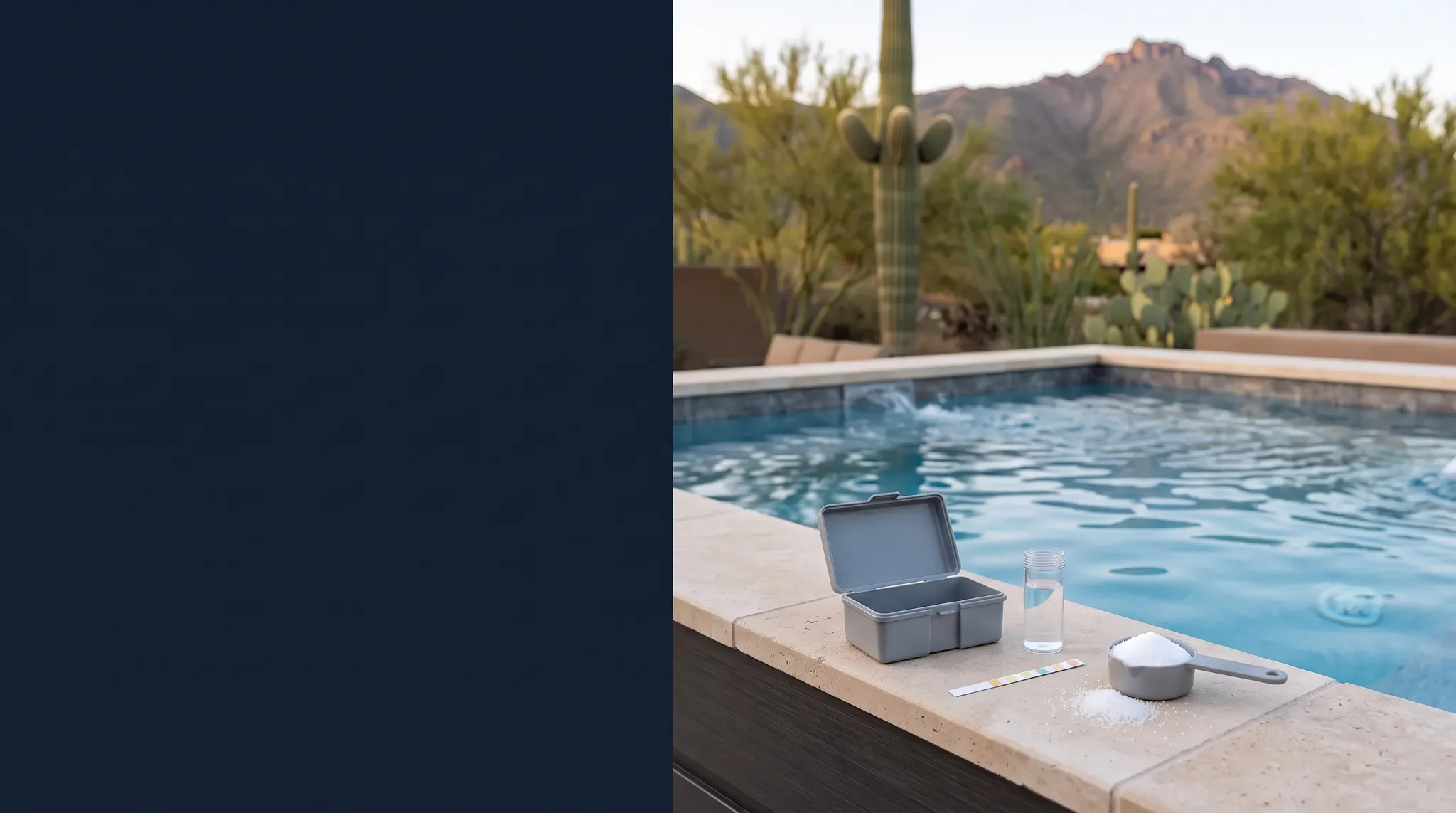
Salt measure and water testing tools beside clear spa water in a Tucson desert backyard

Hot tub water care · Tucson, Arizona

A clear guide to salt water systems.

Salt systems generate chlorine from dissolved salt. They can simplify part of water care, but they do not replace testing, balanced water, filter care, or model-specific maintenance.

Saltwater is still chlorine Every system needs testing

What a salt system actually does

Salt in. Chlorine generated. Testing still required.

A salt water system uses dissolved salt and electrolysis to produce chlorine inside the water-care equipment. In a pool, water passes through a generator cell. In a compatible spa, the system may use an integrated cell or replaceable cartridge. Either way, chlorine remains the sanitizer.

A salt system can automate part of chlorine production, but it cannot measure every source of sanitizer demand. Sunlight, Tucson heat, heavy use, cosmetics, dust, circulation, and filter condition can all change what the water needs. The CDC recommends routine chlorine and pH testing, while the current manufacturer manual sets the exact operating range for the equipment.

What owners are comparing

The appeal is simpler chlorine production, not zero maintenance.

A salt system may reduce one kind of work, but it replaces manual chlorine dosing with a different routine. The right fit depends on compatible equipment, owner expectations, and the support available for testing and replacement parts.

Potential benefits

  • Automatic chlorine generation can reduce repeated manual dosing and chemical handling.
  • Many owners prefer the feel of properly balanced salt-treated water.
  • Stable chemistry can reduce the sharp odor associated with chloramines and poorly managed water.
  • Some cartridge-based spa systems can extend drain intervals under manufacturer-stated conditions.

Tradeoffs to plan for

  • Initial equipment or replacement-cartridge cost.
  • Regular testing and output adjustments.
  • Cell cleaning, cartridge replacement, or system-specific service.
  • Compatibility limits and water-balance demands that can affect scale and corrosion.

A repeatable care rhythm

Test, balance, confirm output, and maintain the equipment.

Automatic generation is only one part of water care. A steady routine keeps sanitizer production, water balance, circulation, filtration, and the cell or cartridge working together.

01

Test sanitizer and pH

Use the method required by the system. Check more often after heavy use, a large adjustment, contamination, or a period of neglect.

02

Balance the water

Maintain pH, alkalinity, calcium hardness, and any system-specific targets in the current owner’s manual.

03

Confirm chlorine output

Increase or reduce the generator setting based on testing rather than assuming the automatic system is keeping pace.

04

Maintain circulation and filters

Salt generation does not remove debris, oils, or suspended particles. Keep filters and circulation operating as directed.

05

Service the cell or cartridge

Calcium scale can reduce cell performance. Cartridge life, cleaning methods, and replacement timing vary by system and use.

06

Drain and refill when required

Water age depends on the system, bather load, chemistry, and manufacturer instructions. One-year water life is not a universal result.

Tucson water note

Hard water, heat, dust, and evaporation can change water balance and scale risk. Use only products and procedures approved for your equipment. A free water analysis can give you a reliable starting point before making a large adjustment.

Free Water Analysis

A legacy FreshWater example

The old guide’s details still need a product label.

The legacy Tucson Pool & Spa article used the FreshWater Salt System on Caldera spas as its example. Current Hot Spring documentation confirms the routine at right for that specific system.

Those details do not transfer automatically to another brand or model. Tucson Pool & Spa’s current hot tub focus is Sundance Spas, whose current acrylic models use CLEARRAY Active Oxygen with UV-C rather than the legacy FreshWater salt system. Confirm the installed system before buying cartridges, salt, test strips, or sanitizer.

  • Test and balance the spa water and confirm output at least every 10 days.
  • Replace the chlorine-generating cartridge at about four months, depending on use and proper care.
  • Water can last up to a year only under the manufacturer’s stated operating conditions.
  • Its current startup guide allows chlorine, MPS, and silver, but not bromine or biguanide.

Other water-care approaches

Different systems solve different parts of water care.

Salt generation, direct sanitizer dosing, and supplemental systems can all produce clean water when the equipment, chemistry, testing, and maintenance routine match.

ApproachWhat it doesOwner workBest fit
Salt-based chlorine generationProduces chlorine from dissolved salt through an electrolytic cell or cartridge.Test water, balance chemistry, adjust output, and clean the cell or replace the cartridge as directed.Compatible systems whose owners want less manual chlorine handling.
Traditional chlorine or bromineAdds sanitizer directly according to test results and current product instructions.Test consistently, dose accurately, maintain filters, and drain and refill as required.Broad equipment compatibility and owners comfortable with a direct dosing routine.
Supplemental ozone, UV-C, MPS, or mineralsSupports oxidation or water treatment and may reduce sanitizer demand in compatible systems.Maintain the supplemental equipment while continuing approved sanitizer, testing, and filtration.Spas designed around the installed supplemental system, including current Sundance CLEARRAY models.

Pool systems

A plumbed generator cell

Pool water usually passes through a generator cell in the equipment system. Output, run time, salt level, water temperature, scale control, and the pool’s full chemistry determine performance.

Spa systems

An integrated cell or cartridge

A compatible spa may use a cartridge or integrated generator with its own salt target, output controls, test products, and replacement schedule. Hot water and a smaller volume change sanitizer demand quickly.

Do not copy a pool salt routine into a hot tub. Never estimate salt from another system’s instructions. Excess salt, poor balance, and scale can damage equipment or make the generator ineffective.

Salt water FAQ

The questions behind the old guide, answered more precisely.

Is a salt water spa chlorine-free?

No. A salt system uses dissolved salt to generate chlorine. The convenience comes from producing sanitizer in the system instead of relying only on repeated manual additions.

Will a salt system eliminate chlorine odor?

Properly managed salt-treated water may have less sharp odor, but odor depends on water balance, contaminants, circulation, and combined chlorine. A strong chemical smell usually points to a water-quality problem, not too much clean chlorine.

How often should I test the water?

Follow the current manual and test more often after heavy use or a water change. The FreshWater example calls for a water and output check at least every 10 days. If the water looks, smells, or feels different, test before use.

How long does a salt-system cartridge last?

It depends on the system. The current FreshWater owner’s manual says its cartridge typically lasts four months. Generator cells used in pools follow a different inspection, cleaning, and replacement schedule.

How much salt should I add?

Use the exact calculation and target in the current manual for the system and water volume. The old page’s cup-based estimate and fixed ppm range are not safe universal instructions.

Can I use silver, MPS, bromine, or other products?

Only when the manufacturer says they are compatible. The current FreshWater startup guide allows chlorine, MPS, and silver, but excludes bromine and biguanide. Other systems can have different rules.

Is salt water non-corrosive?

No water-care method is automatically non-corrosive. Incorrect pH, alkalinity, calcium balance, salinity, or sanitizer level can damage equipment and surfaces. Balanced water and system-specific maintenance are essential.

Bring us a water sample

Start with the water you have.

Bring a pool or spa water sample to Tucson Pool & Spa for a free analysis. Tell the team which system and model you own, when the water was last changed, and what products you have used. Call ahead if you need to confirm testing availability or a specific replacement item.

Free pool and spa water analysis

(520) 296-0993

170 N Harrison, Tucson, AZ 85748